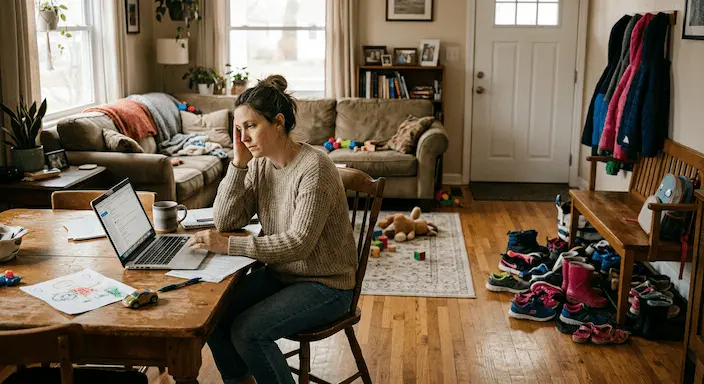
There's a moment that happens every summer, usually sometime around the second week of June.
The novelty of no school has worn off. The kids are bored — or wired — or fighting over nothing at all. You've already had the "I don't know, what do you want to do" conversation seventeen times. The laundry is piling up because the routine that made everything run smoothly in May has completely evaporated. And you're tired in a way that's hard to explain because — weren't you supposed to be relaxed by now?
That moment is not a sign that something is wrong with you. It's a sign that you're a person navigating a real transition. And summer is one of the most disruptive ones families face every year.
Why Summer Hits Harder Than We Expect
There's a cultural story about summer that most of us absorbed somewhere along the way: it's the fun season. The reward season. The season where things get easier, not harder.
And in some ways, summer is wonderful. The longer days. The slower mornings. The kids home. The chance to be together.
But "together" is also a stress multiplier for families that aren't expecting it. When school is in session, there's a structure that absorbs a lot of family friction. Everyone has places to be. Transitions are built in. The day has a shape.
When summer arrives, that structure disappears almost overnight — and what replaces it is a lot of unstructured time, closer quarters, more competing needs, and adults who are still expected to work, keep the house running, and somehow maintain their own wellbeing while doing it.
Research on family stress consistently points to transitions as some of the highest-risk periods for conflict and mental health struggles — not just the big ones like divorce or job loss, but the repeated, seasonal transitions that happen year after year. (This is a well-documented pattern in family systems research; the American Psychological Association has published on transition stress in families.) Summer is one of those transitions. It just doesn't get talked about that way.
What Changes When Summer Starts
The list of things that shift when school lets out is longer than most families realize until they're inside it:
None of this makes summer bad. But it does make summer a season worth paying attention to.
The Parent Piece
One of the things we hear most often from parents in the summer is some version of this: "I feel guilty for not enjoying this more."
If your kids are finally home, and summer is supposed to be the good season, and you find yourself depleted, irritable, or quietly dreaming about September — the guilt can be significant. Like there's something wrong with the way you're loving your family.
There isn't. Parenting is hard. Parenting during an abrupt schedule change with no structure and maximum noise is harder. The guilt doesn't help. And it tends to compound the exhaustion.
For parents who are already managing anxiety or depression — and there are a lot of them — summer's disruption of routine can trigger a slide that surprises them. Routine is one of the most powerful stabilizers for mental health. When it goes, the effects are real.
The Kid and Teen Piece
Kids need structure even when they say they don't want it. The research here is pretty clear: children — especially those with anxiety, ADHD, or a history of trauma — depend on predictability as a form of emotional regulation. When predictability disappears, behavior often tells the story.
For adolescents, summer is its own particular challenge. They're at a developmental stage where they're trying to figure out who they are — and summer removes the school context that gives them social footing, routine, and identity. Some teens thrive. Others struggle in ways that can look like laziness, defiance, or withdrawal — but are often actually anxiety or depression in disguise.
Thomas Parker, our therapist who specializes in children, adolescents, and trauma, sees this pattern every summer. If your teenager seems to be disappearing into their room or their phone, or suddenly seems more irritable or flat, it's worth paying attention to. That shift often has something real underneath it.
The Couples Piece
Here's the one that catches most couples off guard: summer doesn't just stress parents. It stresses marriages.
When the routine changes, the quiet rhythms that sustain a relationship — the morning coffee before the kids wake up, the after-work debrief, the weekend habits that help you stay connected — those tend to get crowded out. Suddenly you're co-managing a chaotic household in close quarters, with less sleep and more demands, and you haven't had a real conversation in two weeks.
Resentment builds quietly in those conditions. And it tends to look like small friction, not big conflict — until it doesn't.
We explore the couples angle more specifically in our post on When Summer Strains a Marriage: What Couples Need to Know, but the short version is this: the transition into summer is a good time to be intentional about your relationship, not to coast on it.
You Don't Have to Figure This Out Alone
If summer is feeling harder than you expected — for you, for your kids, for your marriage — that's worth taking seriously.
WholeHearted Counseling serves families across Northwest Arkansas, including Bentonville, Rogers, Fayetteville, and the surrounding communities. We also see clients via telehealth from SW Missouri and NE Oklahoma who are looking for a good fit.
We work with individuals, couples, children, and adolescents. And we specialize in exactly the kinds of transitions that summer brings.
whc-ar.com — reach out whenever you're ready.
This is part of our June 2026 series "When Everything Changes." Continue reading: Your Kids Aren't Just Bored: What Summer Behavior Is Really Telling You, When Summer Strains a Marriage: What Couples Need to Know, and The Summer Slide: When Anxiety and Depression Follow the Schedule Change.